
Table of Contents
LED furniture lighting helps make storage and work more convenient: illuminating shelves, niches, display cases, and kitchen work areas increases visibility and adds a subtle decorative accent. Recessed lighting highlights the texture of materials, highlights objects, and visually lightens massive structures.
This type of lighting on https://leduastore.com/furniture-lighting-ledua-brand/ is used in kitchen cabinets, wardrobes, walk-in closets, shelving units, cabinets, display cases, and even headboards. With the right choice of brightness and light temperature, you can achieve both functional lighting and soft, atmospheric illumination.
Advantages of LED Furniture Lighting
Efficiency and Durability. LEDs consume little energy and last significantly longer than traditional lamps, which is especially important for daily use in kitchens or dressing rooms.
Safety and Low Heat. LED strips and luminaires generate virtually no heat, making them suitable for installation near wood panels, plastic elements, and textiles, provided proper installation and ventilation of the power supply are observed.
Design Flexibility. Strips, linear profiles, spotlights, surface-mounted and recessed solutions, and options with sensors and dimming are available. You can choose warm, neutral, or cool light, as well as RGB for decorative effects.
Ease of use. The lighting can be activated by door opening, movement, touch, or a switch. This is convenient when your hands are full, and also helps you quickly navigate the cabinet.
What are the most common lighting options?
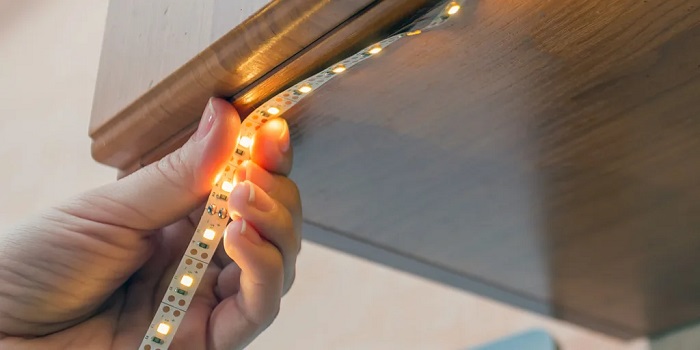
- LED strip – universal for shelves, niches, and the bottom of wall cabinets.
- Linear lights – provide an even light without pronounced points, suitable for the work area.
- Spotlights – look good in display cases and wall units, creating accents.
- Profile with diffuser – protects the strip and makes the light softer and more uniform.
What to look for when choosing
- Brightness (lumens) – higher brightness is needed for the work area, lower brightness is needed for display cases and decorative lighting. Moderate.
- Color Temperature: Warm (cozy), Neutral (natural), Cool (maximum contrast).
- Power Supply: 12/24 V (via power supply) or 220 V (requires increased safety).
- Protection (IP): For the kitchen near the sink, it is better to choose solutions with increased moisture protection.
- Controls: Switch, dimmer, sensor, opening/motion sensor, smart home compatibility.
What tasks does LED furniture lighting solve in the interior?
LED furniture lighting simultaneously solves practical and decorative problems: it makes storage and work areas convenient, and the interior visually more “put together” and modern. With the right choice of brightness, color temperature, and installation method, it becomes part of the lighting scheme, not just an additional lamp.
Unlike general lighting, furniture lighting works precisely: it highlights specific surfaces and objects without overloading the room. This is especially important where convenient navigation, accurate presentation of contents, and accurate rendering of material textures are required.
- Enhances functionality: illuminates work areas, countertops, shelves, and cabinet interiors, reducing dependence on overhead lighting.
- Simplifies searching and navigation: helps quickly find items in deep sections, drawers, and closets, reducing the number of “blind” spots.
- Creates comfortable lighting scenarios: soft ambient lighting in the hallway, night lighting in the bedroom, and ambient lighting in the kitchen without excessive brightness.
- Emphasises design and materials: highlights the texture of wood, stone, and glass, accentuates niches, display cases, and open shelving.
- Zones space: visually separates the kitchen and It enhances the living room, work, and relaxation areas, making the furniture composition more expressive.
- Improves safety: Illuminating steps, baseboards, walkways, and corners reduces the risk of tripping at night.
- Saves energy: With the right wattage and the use of sensors/dimmers, it provides the necessary light with minimal consumption.
Bottom Line: LED furniture lighting on https://leduastore.com/interior-lighting-ledua-brand/ makes the interior more comfortable, neater, and more expressive, helping to simultaneously address lighting, zoning, and decorative needs. Optimal results are achieved through thoughtful placement, correct brightness, and the appropriate color temperature for a specific area.