
Table of Contents
A knotted rug is one of the most revealing objects in the world of interior craft. At first glance it is simply a textile floor covering. Look closer and you find a structure built thread by thread, knot by knot, by hands that understand tension, fibre, rhythm and design in a way no machine can imitate. To understand what a knotted rug truly is, one must think not only of construction but of culture, time and the patient intelligence of materials. It is a technique that has survived because nothing else produces the same depth of colour, resilience or tactility. For anyone exploring hand knotted rugs for their home, this quiet complexity is precisely what makes them magnetic.
How a Knot Becomes a Surface
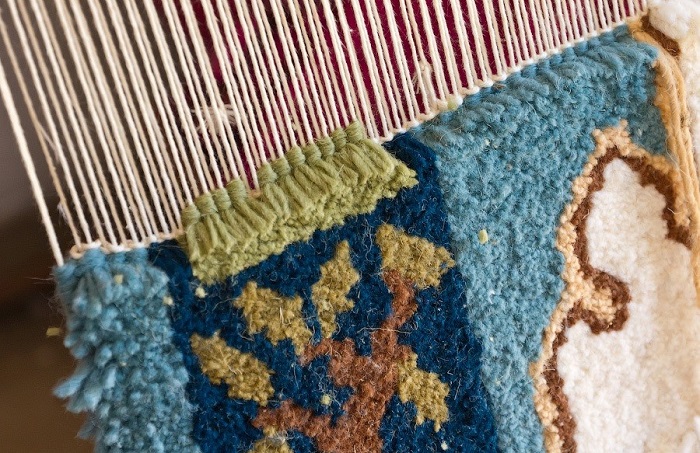
At its simplest, a knotted rug is created by tying individual knots onto a vertical foundation of warp threads, then securing each line with a weft. The principle is almost disarmingly straightforward, yet the execution calls for precision worthy of a jeweller. Each knot becomes one tiny point of colour within the design. Millions of knots build an image with the density and nuance of a painting. The number of knots per square inch often becomes shorthand for quality, but this is only part of the story. A relatively low knot count can still produce a remarkable rug if the wool is tightly spun, if the pattern is well scaled, if the dyestuffs are lively and balanced. Likewise, a very high knot count delivers buttery detail only when the hand behind it is experienced enough to maintain even tension without hesitation.
The two dominant knotting techniques, the Persian (also called Senneh) and the Turkish (Ghiordes), reveal how artisans solve the same structural challenge in different cultural languages. The Persian knot is asymmetrical, allowing more flexibility and a slightly finer drawing of curves. The Turkish knot is symmetrical, gripping the warps more firmly and producing a subtly fuller pile. Neither is inherently superior. Each suits different regions, traditions and design ambitions. A Heriz rug depends on the solidity of Turkish knotting; a silk Tabriz relies on the fineness afforded by the Persian knot. Part of the pleasure for seasoned collectors lies in recognising these structural dialects at a glance.
The Materials Behind the Magic
Knotted rugs are narratives written in fibre. Wool is the hero in most stories, prized for its spring, resilience and ability to drink dye deeply without losing its natural softness. Highland wool from the Caucasus behaves differently from New Zealand wool or Persian kurk wool. The former offers a slightly crisp tactility that holds geometric designs with confidence; the latter yields a refined lustre that elevates floral or pictorial motifs. When artisans combine differing wools in a single rug, the result can resemble a conversation between textures.
Silk introduces another register altogether. It reflects light with a quiet brilliance, turning certain details into glimmers that shift as you move. In fine city workshops, especially those of Qum and Hereke, silk is used not only for highlights but for the entire pile. These rugs almost defy the term “carpet”; they behave more like woven jewellery or textile paintings. Cotton, meanwhile, is the common choice for warps and wefts because it keeps the foundation stable, preventing distortion as the decades pass. Some tribal weavers prefer wool foundations, maintaining a fully organic structure that ages with a pleasing harmony.
Time as a Hidden Ingredient
A knotted rug is slow craft by definition. Even a moderately sized piece can take months, and a large or extremely fine one may occupy a small workshop for a year or more. This investment of time becomes tangible every time the rug is walked upon. You feel the difference between an object made to meet a deadline and one built at the tempo of human hands. The rhythm of tying knots is neither hurried nor languid; it is metronomic, meditative. Mistakes are corrected, designs are adjusted in situ, tensions are subtly recalibrated. No algorithm optimises this process and no loom can be programmed to imitate it convincingly.
The slowness also allows for thoughtful dyeing cycles. Artisans who work with natural dyes often wait for the right season to harvest plants or for cooler days to achieve deeper oxidation. Madder roots, indigo and walnut husks respond to temperature, water hardness and pH, meaning that identical recipes can produce varying shades from one year to the next. These nuances give knotted rugs their unmistakable vitality. Synthetic azo dyes, used widely since the late nineteenth century, can be excellent when applied with care, but they lack the subtle irregularities that collectors call “abrash”. This colour modulation resembles the way light behaves on stone or wood. It makes a rug feel alive rather than manufactured.
Design as Memory and Innovation
Although many people think of knotted rugs as traditional, the vocabulary of motifs is anything but static. Tribal weavers often treat patterns as living memory – adaptable, open to reinterpretation. A repeated gül in a Turkmen rug may look ancient, but the specific interplay of scale and colour in that one example might never appear again. City workshops, on the other hand, engage in a kind of architectural design. Master cartoonists translate influences from miniature painting, Islamic geometry, European Art Nouveau or, in the case of modern Iranian studios, even contemporary graphic art.
The tension between tradition and innovation is one reason knotted rugs remain relevant to today’s interiors. Minimalist homes often favour the grounded presence of Afghan kilim-inspired knotted pieces with subdued palettes. Meanwhile, maximalist spaces welcome the exuberance of Kashmiri silk florals or Indian Mughal-inspired motifs. Designers looking to soften a strong architectural line frequently use a fine Persian rug to introduce curvature and visual rhythm. The weave quite literally warms a room, not just through insulation but through pattern that feels human-scaled.
Durability and the Question of Authenticity
One of the most persistent myths is that all hand knotted rugs are fragile. In reality, a well-made knotted rug can withstand generations of use. The pile compresses gracefully rather than wearing into bald patches, especially when the wool has retained its natural lanolin. The structure is inherently reparable. A skilled restorer can reweave damaged sections knot by knot, recreating pattern and colour with almost forensic precision. Antique rugs that are still in service today, from Bakhtiari gardens to Kerman medallions, testify to the longevity of the technique.
What makes authenticity an ongoing conversation is the market’s enthusiasm. Mass-produced machine-made carpets often mimic traditional patterns, but the illusion dissolves as soon as you touch the surface. The pile behaves uniformly, without the microvariations that hand spinning introduces. The design tends to feel flatter, more synthetically perfect, and the back reveals a printed lattice rather than genuine knotting. Knowing the difference matters not only for aesthetic reasons but because a knotted rug carries value that holds or even increases over time when maintained properly. Interior designers often describe them as functional art. They do not simply decorate a room; they anchor it.
The Knotted Rug in Contemporary Homes
In modern interiors, the knotted rug plays multiple roles simultaneously. It can act as a visual foundation, a piece of cultural storytelling or a counterbalance to sleek surfaces. Concrete floors, brushed metal furniture and glass partitions can feel chilly without a textural foil beneath them. A knotted rug offers exactly that, but without forfeiting sophistication. Designers often choose large neutral rugs with minimal pattern for open plan living areas, allowing architectural forms to dominate while still adding warmth. In contrast, studies, libraries and bedrooms frequently benefit from richer, more concentrated designs that create intimacy.
Colour selection evolves too. Natural palettes of undyed wool suit Scandinavian-inspired palettes, while jewel tones – emerald, pomegranate, lapis – find renewed relevance in moody, jewel-box interiors. Contemporary weavers in Nepal and India have proven adept at translating abstract or painterly concepts into knotted form, producing rugs that comfortably sit within minimalist or art-driven homes. These pieces demonstrate that the technique is not frozen in time. It is adaptable, responsive and capable of absorbing influences from global design movements.
How to Choose a Knotted Rug
Selecting a knotted rug begins with tactile experience. The hand feel tells you far more than any specification sheet. Run your fingers through the pile – is it springy, silky, dense, or crisp? Next, turn the rug over. The clarity of the pattern on the back reveals both knot type and quality of execution. Check for even tension across the warp; a subtle ripple here and there is acceptable, but major distortions may indicate structural problems. When considering colour, look for harmony rather than perfection. Slight variations are a hallmark of authentic dyeing and should be embraced, not feared.
Scale is another crucial factor. A rug that is too small rarely flatters a room, especially in modern layouts where furniture is often larger and more sculptural. Allow the front legs of sofas and chairs to rest on the rug to create cohesion. Finally, consider where the rug will live. High traffic areas benefit from robust wools with medium pile, while low traffic rooms can accommodate finer, more delicate weaves. A carefully chosen knotted rug does not merely fill a space; it shapes it.
A Tradition That Refuses to Fade
To understand what a knotted rug is, you must think of it as more than an object. It is a record of labour, of geography, of evolving aesthetic ideals. It ties together ancient craft and contemporary interiors with remarkable grace. The technique has endured because it rewards both makers and owners. It keeps the hands of artisans relevant and reminds us, within increasingly digital homes, that some forms of beauty take time.
For anyone seeking a piece that brings depth, texture and cultural resonance to a room, a knotted rug remains one of the few furnishings that grow more interesting the longer you live with them. They are not merely purchased; they are welcomed into the home, where their quiet, enduring presence becomes part of the rhythm of daily life.